Machinery & equipment
Machine bases, guards, housings, and conveyors coated in cutting fluid, lubricants, and shop grime.
- Lock out and tag out equipment before cleaning.
- Apply and let it penetrate.
- Agitate, wipe, or rinse.

Industrial green cleaning
Machinery, oil-stained concrete, docks, and miles of aisle. EcoWash replaces conventional solvent degreasers with a bio-surfactant concentrate that has a flash point above 212 °F, 10.4 g/L VOC, and no DOT hazmat classification. It runs from mop buckets to autoscrubbers to parts tanks.

Manufacturing & warehouse use cases
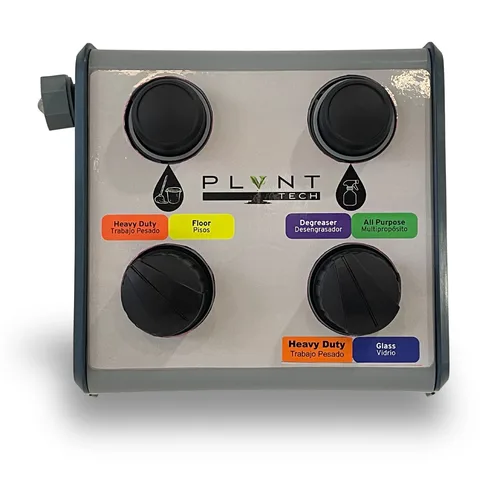
Each setting is the starting-point dilution on the Fusion Pro dispenser. Always follow your site's lockout/tagout and PPE rules.
Machine bases, guards, housings, and conveyors coated in cutting fluid, lubricants, and shop grime.
Drip zones under machines, hydraulic-fluid spots, and the haze that makes concrete slippery.
A water-based, solvent-free alternative for parts washing and tool cleaning.
Daily aisle cleaning with ride-on or walk-behind autoscrubbers.
Dock plates, levelers, overhead doors, and compactor and dumpster pads.
Employee break rooms, locker rooms, and restrooms.
Warehouses & distribution
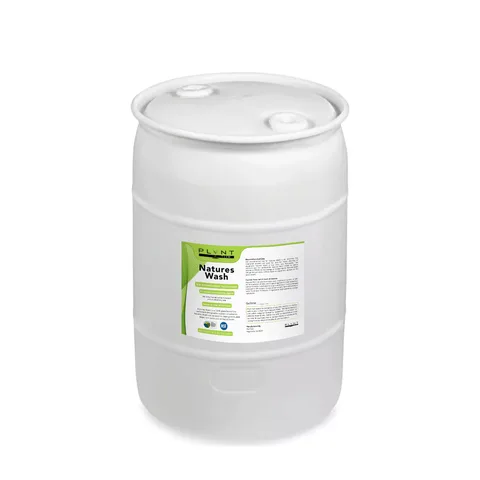
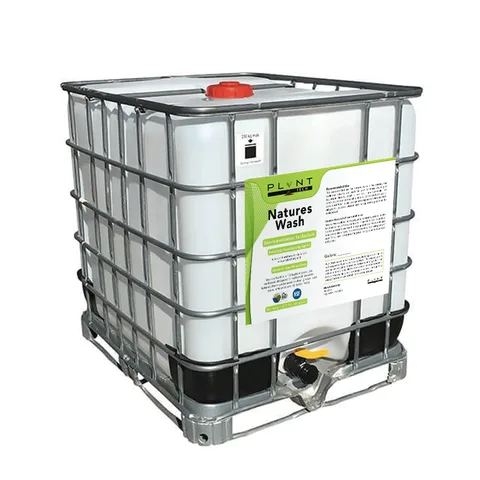
At 64:1, one 55-gallon drum makes about 3,575 gallons of autoscrubber solution, and one 275-gallon tote makes about 17,875 gallons. At the tote price, that's roughly $0.77 per ready-to-use gallon. Concentrate ships as non-hazmat freight.
Keep heavy duty wipes on forklifts and at pack stations for controls, scanners, and greasy hands-on surfaces.

The mechanism
Our proprietary bio-surfactant is on the FDA GRAS list. Each molecule has a water-loving head and an oil-loving tail. In water, the molecules form nanoscale particles called micelles that encapsulate oil, grease, and grime, so the soil rinses away instead of re-depositing. Each micelle is about 1.2 to 4 nanometers across.
Oil-loving tails anchor into grease and food or machine soil and break its grip on the surface.
The molecules close around the soil in nanoscale micelles with the water-loving heads facing out.
The micelles stay suspended in the rinse water and wipe or mop away cleanly.
After rinsing, microbes biodegrade our primary surfactant, sodium tallate (a tall oil soap), to carbon dioxide, water, and biomass. See the published data.

Illustration, not to scale. Step 4, biodegradation after rinsing, is described above.
Proof & compliance
No compromises. No vague claims. Only results backed by proof.
Straight answers
It is designed to replace conventional solvents for cleaning and degreasing. With a flash point above 212 °F and VOC of 10.4 g/L, it removes a flammable solvent from many jobs. Validate on your soils and substrates before switching a production process.
The SDS does not list any metals as incompatible. Its incompatible materials are strong acids, strong bases, strong oxidizers, and strong reducing agents.
Yes. The Floor setting (about 64:1) and Heavy Duty bucket setting (about 15:1) are specified for mop buckets and autoscrubbers.
The SDS (PT-BIOSURF-001, OSHA HCS 2024) lists the product as not classified under OSHA HCS for physical, health, or environmental hazards, with no pictogram and no signal word. It is not classified as a skin or eye irritant: the SDS says it is not expected to cause skin irritation or corrosion at use concentrations, and that product-level eye irritation classification is not warranted. Direct contact may cause mild transient irritation, so avoid direct eye contact. SARA 311/312 hazards: none. No ingredients are on the Prop 65 list, all ingredients are TSCA-listed or exempt, and it is not regulated as dangerous goods for transport.
The specification sheet also lists soil remediation, marine, boat, and deck surface cleaning, and oilfield paraffin and asphaltene removal. Contact us about those applications.
Tell us your square footage, soils, and current degreaser. We will quote drums or totes and a dispensing setup for each area.