Restaurant cleaning

Built for the fryer line, the dish room, and the dining room.

Restaurant cleaning runs on grease: hood filters, fryer cabinets, flat-tops, and the floor under all of it. EcoWash is one bio-surfactant concentrate that goes from 4:1 degreaser to 100:1 glass cleaner. It breaks up grease without petroleum solvents and rinses clean.

Illustration: restaurant cook in nitrile gloves wiping down a stainless fryer cabinet below the hood filters on a commercial kitchen line, with three white spray bottles standing side by side on the stainless ledge, labeled Glass Cleaner, All Purpose Cleaner, and Heavy Duty Degreaser

Use cases

Every greasy surface, front to back

The setting for each job is the starting-point dilution on the Fusion Pro dispenser. "Let it penetrate" means a dwell time long enough for the micelles to lift the soil. Heavier soil needs longer.

Degreaser ≈4:1

Fryers & fryer cabinets

Fryer fronts, cabinets, and splash zones collect polymerized oil that all-purpose cleaners smear around.

  1. Let equipment cool to a safe temperature.
  2. Spray and let it penetrate. Give carbonized areas a longer dwell.
  3. Agitate with a non-scratch pad.
  4. Wipe, then rinse with clean water.
Degreaser ≈4:1

Hood filters

Baffle filters are the biggest grease load in the building and a fire-safety item.

  1. Remove filters and soak or spray in a sink or soak tank.
  2. Let it penetrate, then brush the baffles.
  3. Rinse with hot water, dry, and reinstall.
  4. Record the date on your hood-cleaning log.
Heavy Duty ≈13:1

Kitchen equipment

Exteriors of flat-tops, ranges, reach-ins, prep tables, and shelving.

  1. Spray, let it penetrate, and wipe.
  2. On food-contact surfaces, rinse with potable water.
  3. Sanitize with your registered sanitizer per local code.
Heavy Duty bucket ≈15:1

Grease trap areas

Clean trap lids, rims, and the surrounding floor during scheduled pump-outs and inspections.

  1. Mop or scrub the surrounding floor and lid.
  2. Rinse to the floor drain per your local rules.
  3. Never pour concentrate into the trap to "dissolve" grease. Emulsified grease can pass the trap and violate FOG ordinances.
All-Purpose ≈43:1

Dining areas

Tables, booths, chairs, high chairs, host stands, and condiment stations between turns.

  1. Spray and wipe with a clean cloth.
  2. Follow with sanitizer on tables where your health code requires it.
Heavy Duty ≈13:1 · Glass ≈100:1

Restrooms

Sinks, fixtures, partitions, walls, and mirrors.

  1. Clean fixtures and partitions with Heavy Duty.
  2. Clean mirrors and chrome with Glass.
  3. Disinfect separately with an EPA-registered disinfectant.
Heavy Duty bucket ≈15:1

Dumpsters & dumpster pads

Grease-soaked pads, enclosure walls, lids, and the drag marks between the back door and the bin.

  1. Scrub the pad and enclosure.
  2. Rinse to the sanitary sewer where permitted, and keep wash water out of storm drains.
Floor ≈64:1 · Heavy Duty ≈15:1

High-traffic floors

Front-of-house tile and sealed floors daily, and the grease film under the cook line.

  1. Use Floor in the mop bucket or autoscrubber for front of house.
  2. Step up to Heavy Duty under the line and in front of fryers.
Heavy Duty bucket ≈15:1

Warewash pre-soak

Sheet pans, hotel pans, fry baskets, and racks loaded with baked-on grease.

  1. Pre-soak before the dish machine to loosen soil.
  2. Run through your normal wash, rinse, and sanitize cycle.
  3. This works alongside your dish machine detergent. It does not replace it.

Foodservice & institutional kitchens

Schools, hospitals, corporate dining, and catering

High-volume kitchens have the same grease problems at greater scale, plus a dish room that never stops. Pre-soak pans and racks at the Heavy Duty bucket setting. Clean serving lines, tray carts, and steam-table exteriors with Heavy Duty in the bottle. Run Floor through the autoscrubber in the dish room and corridors.

For multi-kitchen operations, a 55-gallon drum or 275-gallon tote means fewer reorders at the same $50.00 per gallon of concentrate. Fusion Pro stations with locked tips keep every kitchen mixing the same way.

Warewash pre-soak method →

Illustration: institutional foodservice dish room with a worker pre-soaking sheet pans before the dish machine

The program

Set up a restaurant in one visit

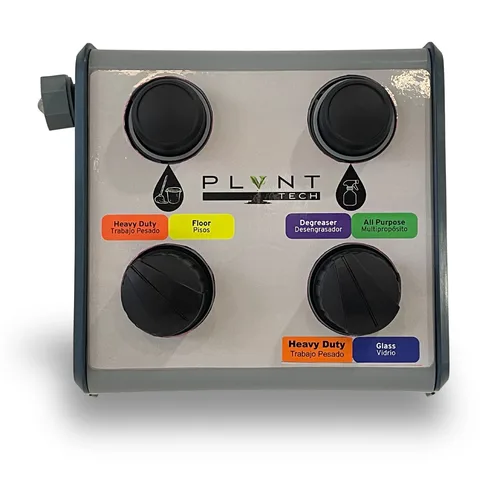
  1. Mount a Fusion Pro

    Install one dispenser near the mop sink. It fills bottles at 1 GPM and buckets at 4 GPM.

  2. Lock the tips

    Set Degreaser, Heavy Duty, All-Purpose, and Glass for bottles, and Floor and Heavy Duty for buckets. Run a volume test.

  3. Label the bottles

    Use one color-coded bottle per setting. The dispenser labels are bilingual (English/Spanish).

  4. Train once

    One product with six settings is easier to train than a shelf of single-purpose chemicals.

The mechanism

How it works: grab, encapsulate, rinse, break down

Our proprietary bio-surfactant is on the FDA GRAS list. Each molecule has a water-loving head and an oil-loving tail. In water, the molecules form nanoscale particles called micelles that encapsulate oil, grease, and grime, so the soil rinses away instead of re-depositing. Each micelle is about 1.2 to 4 nanometers across.

  1. Grab

    Oil-loving tails anchor into grease and food or machine soil and break its grip on the surface.

  2. Encapsulate

    The molecules close around the soil in nanoscale micelles with the water-loving heads facing out.

  3. Rinse

    The micelles stay suspended in the rinse water and wipe or mop away cleanly.

  4. Break down

    After rinsing, microbes biodegrade our primary surfactant, sodium tallate (a tall oil soap), to carbon dioxide, water, and biomass. See the published data.

Illustration in three panels showing how the bio-surfactant removes grease. 1 Grab: surfactant molecules, each with a round water-loving head and a thin oil-loving tail, push their tails into an amber grease film on stainless steel while their heads stay in the water. 2 Encapsulate: a cut-away micelle with heads facing outward and tails pointing inward around a trapped oil core. 3 Rinse: closed micelles carrying the oil are swept away by rinse water, leaving the steel surface clean.
  1. Grab. Oil-loving tails (ivory) anchor into the grease (amber). Water-loving heads (teal) stay in the water.
  2. Encapsulate. Cut-away micelle: heads face out, tails point in, and the oil is trapped in the core.
  3. Rinse. Closed micelles carry the oil off the surface and away in the rinse water.

Illustration, not to scale. Step 4, biodegradation after rinsing, is described above.

Read the full chemistry, ingredients, and data →

Proof & compliance

Built to fit a health-code kitchen

No compromises. No vague claims. Only results backed by proof.

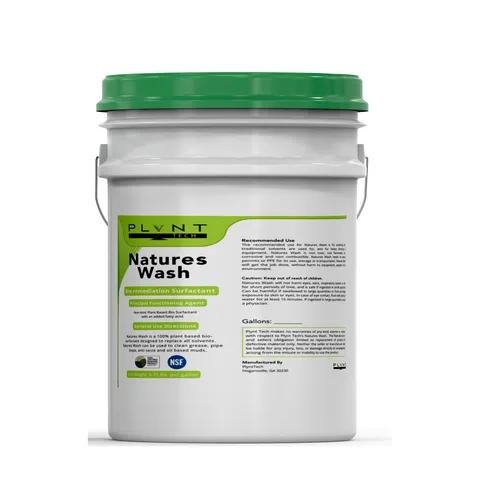
  • NSF Nonfood Compounds registeredCertificate C0838274-02, issued February 19, 2026.
  • Not a fire hazardFlash point >212 °F. Keep flammable solvent degreasers away from hot lines.
  • Cleaner, not sanitizerFollow with your EPA-registered sanitizer on food-contact surfaces, per local health code.
  • Practically non-toxic by acute exposureAcute oral ATE >5,000 mg/kg. Not classified under OSHA HCS, with no signal word. Direct contact may cause mild transient irritation, so goggles and gloves are good practice when handling concentrate.

Straight answers

Frequently asked questions

Is Nature’s Wash a restaurant degreaser or a sanitizer?

It is a cleaner and degreaser. It is not an EPA-registered sanitizer or disinfectant. Clean first with Nature’s Wash, then sanitize food-contact surfaces with your registered sanitizer as your health code requires.

Can I use it on food-contact surfaces?

Yes, as a cleaning step. The concentrate is registered in the NSF Nonfood Compounds program (certificate C0838274-02). Rinse food-contact surfaces with potable water after cleaning, then sanitize.

Will it help with grease traps?

Use it to clean around traps, on lids, and on surrounding floors. Do not pour surfactants into a trap to break up grease. Emulsified grease can pass through and cause FOG ordinance violations downstream.

How many products can it replace?

One concentrate covers six dilutions through the Fusion Pro: glass, all-purpose, heavy duty (bottle and bucket), degreaser, and floor. How many products that replaces depends on what you stock today.

What PPE do staff need?

Splash goggles and nitrile or neoprene gloves when handling undiluted concentrate. At working dilutions, latex or nitrile gloves are sufficient.

Run it on your worst fryer.

Tell us how many locations you have and what your toughest soil is. We will quote the right package and a Fusion Pro setup for each kitchen.